
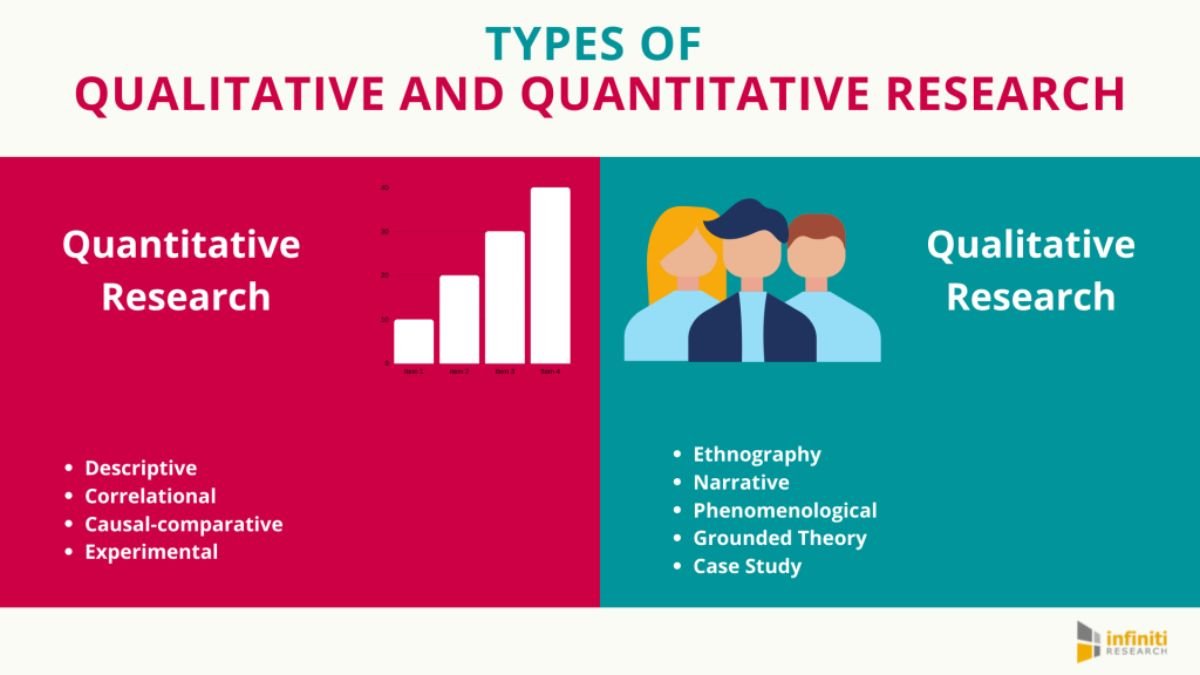
In research, we often need to understand the difference between two main types of research methods: Quantitative Research and Qualitative Research. Whether you’re in academia or working in business, marketing, social science, or any other professional field, it’s important to understand which research method is useful when. In this blog, we’ll explain the differences between these two research types in a simple and clear way through 10 key points.
The Basic Purpose of Research
The primary purpose of quantitative research is to quantify data and draw accurate conclusions. This research typically attempts to explain “what is happening?”
Qualitative research, on the other hand, aims to understand thoughts, experiences, and emotions. This research explores “why” and uncovers the underlying causes.
For example, if a company wants to increase sales of its product, quantitative research will reveal how many people purchased it, while qualitative research will help understand why some people like or dislike the product.
Types of Data
Quantitative research uses numerical data. It measures data using surveys, tests, and metrics.
Qualitative research uses descriptive data. It gathers in-depth information through interviews, focus groups, observations, and case studies.
In short, quantitative data reflects “how much?” or “what percentage?”, while qualitative data helps understand “how?” and “why?”.
Variety of Research Methods
Quantitative research commonly uses surveys, online polls, statistical analysis, and experiments. Its focus is on the quantity of data, and conclusions are drawn for generalization.
Qualitative research involves methods such as interviews, focus groups, observations, and case studies. Its focus is on gaining in-depth information and understanding patterns.
This distinction explains why quantitative research is “precise and measurable,” while qualitative research is “descriptive and empirical.”
Data Collection Process
Data collection in quantitative research is systematic and structured. Questions and options are predetermined, making research results easily comparable and reliable.
Data collection in qualitative research is flexible and unstructured. Researchers can adapt questions to suit circumstances and draw in-depth conclusions.
This means that quantitative research is more formal, while qualitative research is more informal and open-ended.
Data Analysis
Quantitative research is analyzed using statistical tools and graphs. This is easier because the data is presented in numbers, and conclusions can be drawn quickly using computer software.
In qualitative research, analysis is thematic, content-based, and interactive. The researcher identifies patterns and themes in the data and draws in-depth conclusions.
In essence, quantitative data is “measured,” while qualitative data is “understood.”
Results and Conclusions
Quantitative research results are precise and measurable. You can clearly tell what percentage of people engage in a particular behavior.
Qualitative research results are descriptive and insightful. It reveals your thoughts and experiences, but not directly reflected in statistics.
For example, Quantitative Research might say that 70% of people are satisfied with a product, while Qualitative Research would reveal which features of the product people like or dislike.
Time and Resource Demands
Quantitative Research requires less time and resources if the data is large and available digitally. Once the design is ready, it can be executed quickly.
Qualitative Research requires more time and resources. Conducting interviews, focus groups, and case studies requires more effort and attention.
Therefore, Quantitative Research is suitable if you need quick conclusions, but Qualitative Research is better for in-depth understanding.
Generalizability and Reliability
Quantitative Research findings are more generalizable. If the sample is accurate and large, you can apply the findings to the entire population.
Qualitative Research findings are less generalizable. They are based on individual experiences and specific circumstances.
This means that quantitative research is suitable for drawing conclusions on a large scale, while qualitative research provides specific and in-depth understanding.
Areas of Use
Quantitative research is commonly used in business, market research, medical research, and social sciences. It helps make quick and accurate decisions.
Qualitative research is used in psychology, ethnography, marketing strategy, and social studies. It provides in-depth insights.
Both research methods are useful in different situations, and are often used in combination.
Conclusion: Which research method is more accurate?
If your goal is to draw conclusions through numbers and patterns, then Quantitative Research is right for you.
If your goal is to gain experiences, opinions, and deeper understanding, then Qualitative Research is appropriate.
In the academic and professional world, both research methods are often used in combination, which is called Mixed-Methods Research. This gives you both numerical data and qualitative insights.
