
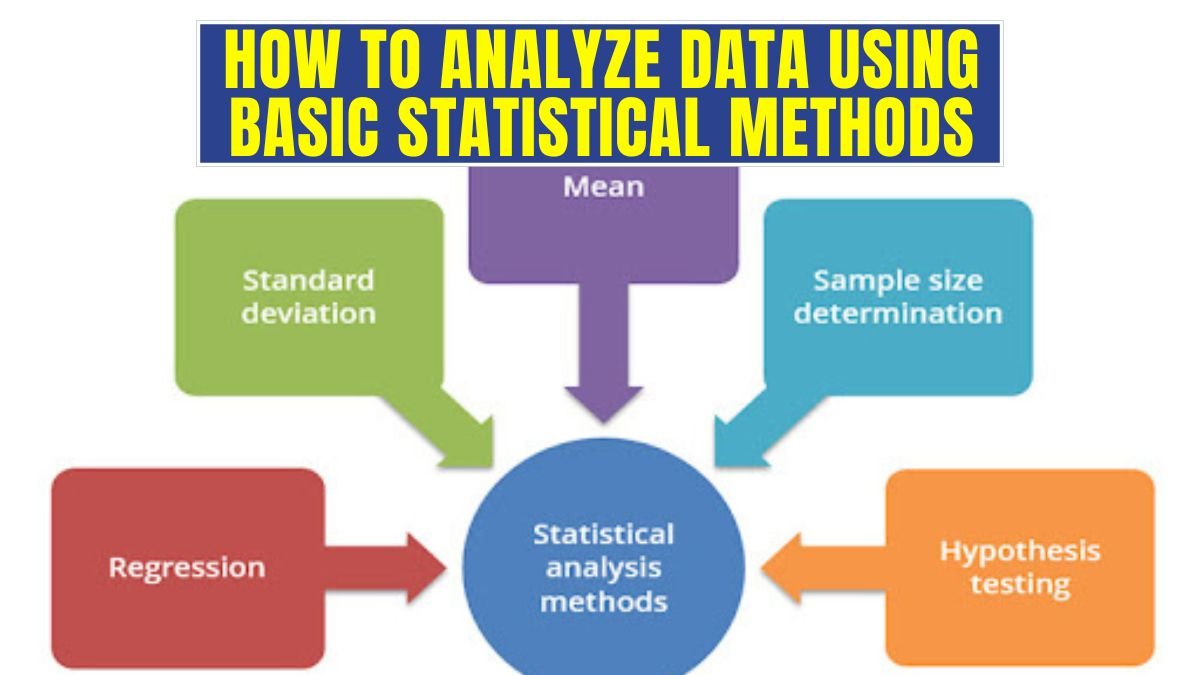
How to Analyze Data Using Basic Statistical Methods: Statistical analysis refers to a process of identifying trends, patterns, and relationships in numerical data. It is a scientific method employed by researchers, governments, businesses, and other organizations to figure out the root causes of a problem or an event. In other words, it is the exact and accurate way of making inferences from data.
Research Planning and Hypothesis Formation
The story of statistical analysis is always started with a hypothesis. A researcher, looking to find a relationship or effect, comes up with a hypothesis, which is known as a statistical hypothesis in the scientific domain.
There are two types of hypotheses:
- Null Hypothesis: This assumes that no effect or relationship exists.
- Alternative Hypothesis: This suggests that an effect or relationship does exist.
For example,
👉 Null Hypothesis: 5 minutes of meditation has no effect on students’ math scores.
👉 Alternative Hypothesis: 5 minutes of meditation improves students’ math scores.
Planning the Research Design
The next step after formulating the hypothesis is to formulate the research design. This determines how data will be collected and what tests will be used.
There are three major types of research designs:
- Descriptive: Understanding the characteristics of a phenomenon or group.
- Correlational: Exploring the relationship between two variables.Experimental: Testing the relationship between a cause and an effect.
For example, if you want to know whether meditation affects students’ test scores, this would be an experimental design.
Measuring and Defining Variables
Every research involves some key variables—such as age, gender, test scores, etc. It is crucial to define and measure them correctly.
Data can be of two types:
- Categorical: Such as gender (male/female) or
- ethnicity.Quantitative: Such as age, marks, height, etc.
For example, “Age” is quantitative data, while “Gender” is categorical data. Identifying the type of variable is important because it determines which statistical test to use.
Understanding Sample and Population
The purpose of every study is to draw conclusions about a population, but it is not possible to collect data from the entire population. Therefore, researchers select a sample that is representative of the population.
A sample can be selected in two ways:
- Probability Sampling: Every individual has an equal chance of being selected.
- Non-Probability Sampling: The sample is selected based on convenience or voluntary selection.
- In an ideal situation, probability sampling is considered preferable because it reduces discrimination and bias.
Determining an Adequate Sample Size
The next step is to determine how many participants the study will have. If the sample is too small, the results will not be reliable, and if it is too large, it will be costly and time-consuming.
Therefore, researchers use online sample size calculators or statistical formulas that include factors such as Significance Level (α), Power, Effect Size, and Population Deviation. A minimum of 30 participants is generally recommended for each group.
Summarizing Data with Descriptive Statistics
Once the data is collected, the first step is to prepare a summary to make it easier to understand.
Key techniques in this step are:
- Measures of Central Tendency: Mean (average), Median (middle value), Mode (highest value).
- Measures of Variability: Range, Standard Deviation, Variance.
For example, if the average score of students before meditation was 68.4 and afterward increased to 75.2, this indicates improvement—but it remains to be seen whether this improvement is statistically significant.
Inferential Statistics for Drawing Conclusions
Inferential Statistics are employed when the intention is to draw inferences about the whole population based on a sample of data. This system is divided into two parts:
- Estimation: Determining the standard or typical value of the population.
- Hypothesis Testing: Verifying if the hypothesis is true by testing.
Here, the researchers might choose to perform a z-test, t-test, ANOVA, regression, or correlation, depending on the situation. For instance, a paired t-test is utilized to compare the results before and after the participants of the same group.
Selection and Use of Tests
Choosing the proper testing method is the key factor in statistical analysis and is your first step. It is determined by the type of data, the sample size, and the research design.
Just as an illustration –
- t-test: Use it for small samples (30 or less).
- z-test: Use it for large samples.
- ANOVA: To make comparisons between three or more groups.
Pearson’s r: To evaluate the association between two quantitative variables. If your data is not in accordance with the necessary assumptions, you may use non-parametric tests instead.
Interpretation of Results
When the tests are completed, researchers interpret the results. Two key aspects emerge during this process:
Statistical Significance: If the p-value is less than 0.05, the results are considered significant.Effect Size: This indicates how practical the results are.are.
For example, if the p-value is 0.0028, it indicates that the results were not simply due to chance, but that meditation actually had an effect.
Conclusion: The Real Point of Statistical Analysis
Statistical analysis is much more than a simple numbers game. It integrates science, logic, and correct data interpretation. Basically, it is the power to decide on the basis of facts. For example, it can be used to show a new drug’s effectiveness or to measure the influence of a government policy.
In fact, planning, data gathering, testing, and interpretation are the different stages of this work, and they are all of the same value. Rightly done, statistical analysis leads us not only to data comprehension but also to finding the causes of the natural world that lie behind data.
Final Thoughts
Statistical analysis forms the researcher’s repertoire without which the work cannot be done. It is not simply a matter of adding or subtracting data but rather the skill of making trustworthy inferences from those data. The success of it depends on whether the right plan, the right sample, the right testing, and the accurate interpretation are there or not.
