
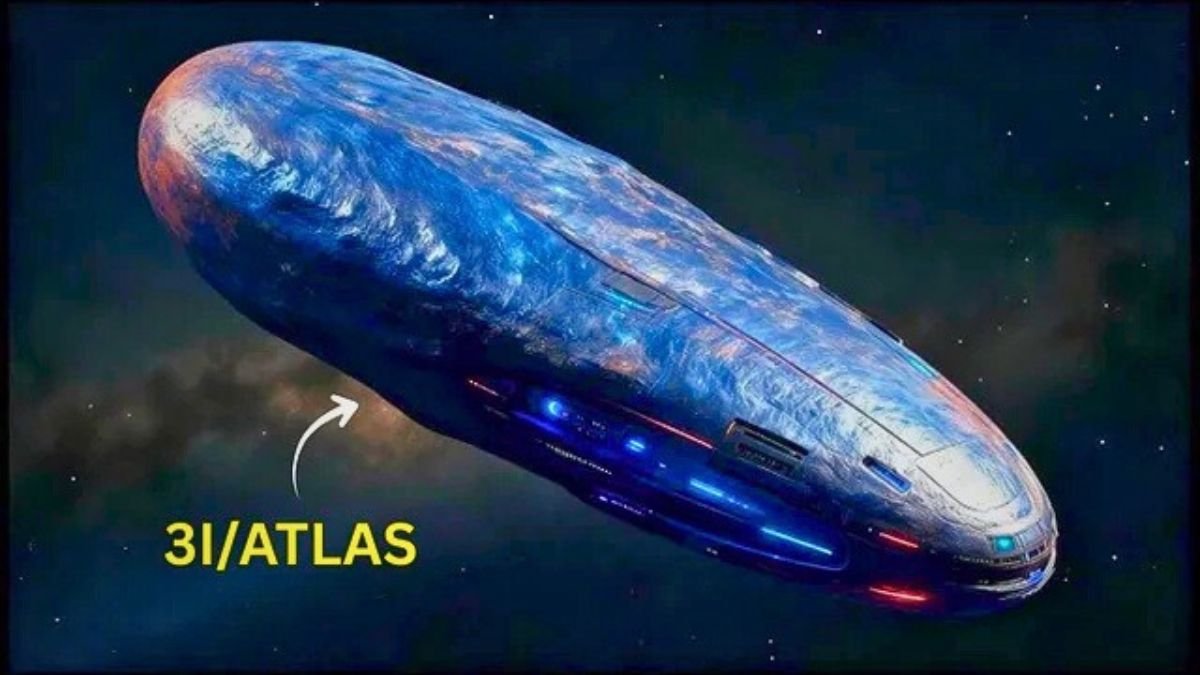
3I/ATLAS Cosmic: Sometimes the universe reminds us that our solar system isn’t a closed room, but a busy hallway. One such reminder has arrived in the form of 3I/ATLAS, a fast-moving, icy messenger from another star system that is now passing through our skies on its one-time journey. It’s only the third known interstellar object ever observed—the first being 1I/ʻOumuamua in 2017 and the second 2I/Borisov in 2019—and it’s already challenging our assumptions, exciting telescopes, and captivating all who have ever looked up and wondered what else is out there.
Think of 3I/ATLAS as a time capsule telling the story of another star’s formative moments. Before it arrived in our sun’s neighborhood, it likely formed around a distant star—a star undergoing its own planet-building process. In their youth, giant planets scatter icy and rocky debris like a cosmic game of billiards. Most of the debris remains in distant reservoirs, but some is ejected into the interstellar void. Occasionally, one of these fragments comes close enough for our telescopes to detect it. 3I/ATLAS is just such a fragment—a discarded remnant from another world’s construction workshop.
Interstellar Identity: The Characteristics of 3I/ATLAS
The biggest clue that 3I/ATLAS originated from another star is its speed and trajectory. Its orbital path is hyperbolic—open, not bound to the sun—and its velocity is too high to have been generated by our planets. It’s simply passing through, not here to stay. The “ATLAS” in its name refers to the survey that discovered it—proving that even patient, sky-scanning telescopes can catch such a cosmic traveler, even if only for a brief time. For scientists, 3I/ATLAS is incredibly exciting because it’s like a natural “sample-return mission”—without a spacecraft. The brightness of its coma (the hazy layer surrounding the nucleus) and the behavior of its dust reveal its chemical and structural properties. Does it contain common ices like water and carbon dioxide? Does it show signs of unusual compounds that don’t survive long near the Sun? How easily does it shed its debris as it heats up? Every answer helps us understand how planets form elsewhere, around different stars and under different initial conditions.
Humanity’s Curiosity: The Thrill of Discovery
There’s also a deeply human side to such discoveries. Astronomers scrambled to book time on large telescopes. Teams worked overnight to plan its trajectory, brightness, and further observations. Amateur observers began scanning the pre-dawn sky, hoping to catch a glimpse. For many, it was a reunion with wonder and curiosity—like the mysterious, sail-like acceleration of ʻOumuamua or the “textbook” comet tail of Borisov. 3I/ATLAS sits somewhere between the two: more clearly cometary than ʻOumuamua, yet still a messenger from some great unknown place.
Will it return?
The answer is no. Interstellar visitors don’t stay in the Sun’s orbit; they pass through only once and then disappear into the galactic stream, pulled along a path under the Milky Way’s gravity that only supercomputers and precise measurements can track. In a few months, it will be gone—another drop in that river of interstellar particles that rarely flows near us. That’s what makes it so precious. Every observation is a one-time event, never to be repeated.
No Danger, Just Science
The word “interstellar” sounds exciting, but 3I/ATLAS poses no threat. This isn’t on a collision course; it’s a scientific gift. If other systems are also flinging out billions of icy fragments, then planets are likely forming, shifting, and evolving throughout the entire galaxy—a thought that is exhilarating for the prospect of life.
If all goes well, astronomers will extract every possible piece of information from this flyby: spectra for chemical analysis, images for studying the dust, changes in brightness to estimate rotation, and a precise determination of its trajectory. A spacecraft intercept is impossible at this time, but the idea of an “interstellar rapid response” mission now seems more practical than science fiction. These messengers are not rare in the galaxy, only in our skies.
A final thought: Ancient ice in the sky
So the next time the sky is clear, go outside. Somewhere, a piece of ancient ice is making its way through the starlight, carrying a message from a nursery that is not our Sun’s. In a noisy world, it offers a simple invitation: Look up, and remember that home is not just Earth—it is something far grander.
FAQs
Q. What is 3I/ATLAS?
A. 3I/ATLAS is an interstellar object, a fast, icy visitor from another star system passing through our Solar System.
Q. How is it different from comets in our Solar System?
A. Its orbit is hyperbolic and its speed is too high to have originated in our Solar System, unlike regular comets that orbit the Sun.
Q. Is 3I/ATLAS dangerous?
A. No, it poses no threat. It is not on a collision course and is purely a scientific opportunity. and is purely a scientific opportunity.
