
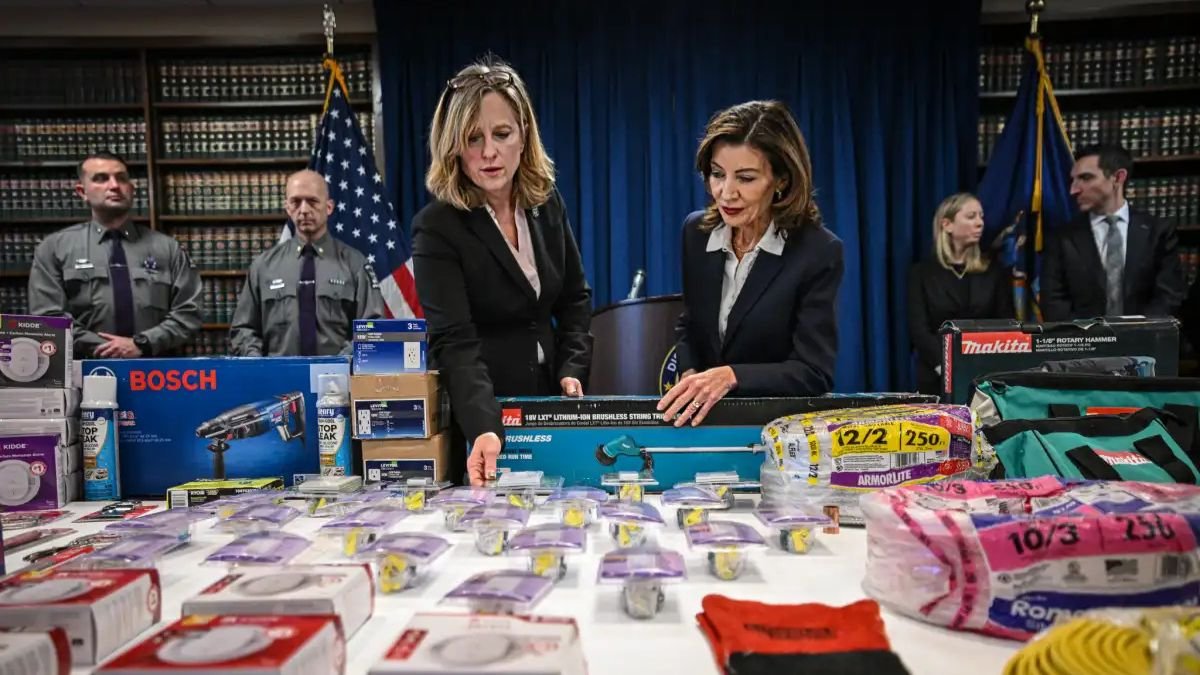
This news from New York City, USA, is not limited to a single criminal case; it reveals how organized retail theft harms the entire system. In a joint statement, Queens District Attorney Melinda Catz and New York Governor Kathy Hochul announced that 780 counts of indictment have been filed against 13 defendants, facing serious charges including grand larceny, criminal conspiracy, and possession of stealing property. This entire network, targeting Home Depot stores, operated in several states.
Theft Network Spanning Nine States
The investigation revealed that this theft ring was not limited to New York. The network targeted Home Depot stores in Delaware, Maryland, Pennsylvania, New Jersey, New York, Connecticut, Rhode Island, Massachusetts, and New Hampshire. A total of 319 thefts occurred from 128 different stores. The total value of the stolen goods over 13 months is estimated to be over $2.2 million.
What items were stolen?
The list of stolen goods reveals the gang’s systematic approach. These included both everyday and high-end items, such as building supplies, power tools, smoke alarms, air conditioners, laundry detergent, and paper towels. These are products that are in high demand, making them easily resold on the black market.
The Journey to the Black Market After the Theft
According to investigative agencies, after the theft, the goods were delivered directly to black market retailers known as “fences.” These fences would pre-determine the goods they wanted and place orders accordingly. These goods were then sold to ordinary consumers, often through a storefront in Brooklyn or online platforms like Facebook Marketplace.
Statement by District Attorney Melinda Katz
District Attorney Melinda Katz called the case “extremely shocking.” He said that 13 accused, over $2.2 million worth of goods, 319 thefts, nine states, and 128 Home Depot stores—these figures themselves demonstrate the severity of this crime. He explained that the accused sometimes targeted the same store four times in a single day and even took breaks for lunch and dinner between thefts. All this demonstrates how brazen and well-planned the crimes were.
Governor Kathy Hochul’s Reaction
New York Governor Kathy Hochul stated that since taking office, her top priority has been reducing crime and ensuring the safety of citizens. Reacting to the surge in retail thefts following the pandemic, she secured funding for a dedicated Retail Theft Task Force and further tightened laws. She stated that strong laws and better resources can deter such organized gangs.
New York State Police’s Strong Warning
New York State Police Superintendent Steven G. James said this case sends a strong message to all criminals who seek to engage in retail theft. He believes the real victims of retail theft aren’t just stores, but customers, employees, and society as a whole. This increases prices and poses a security threat.
Home Depot’s Role and Response
Scott Glenn, Home Depot’s Vice President of Asset Protection, stated that the safety of customers and employees is the company’s top priority. He dubbed the operation “Operation Self Checkout” and explained that this gang had been causing significant losses to Home Depot for years. Although this network targeted Home Depot, organized retail crime has become a major problem nationwide.
Court Action and Threat of Sentencing
Eleven defendants in this case have been arraigned on a 780-count indictment. All are charged with fourth-degree conspiracy, various counts of grand larceny and possession of stolen property. One defendant is currently at large, and one will be arraigned later. If convicted, the gang members face up to 25 years in prison, while Fence faces up to 15 years.
How the Investigation Began
This major case began in June 2024 when the District Attorney’s Detective Bureau observed stolen air conditioners during a separate investigation. The investigation was subsequently expanded, utilizing license plate readers and court-approved electronic surveillance. Home Depot played a key role in the investigation by providing video footage and documentary evidence.
Preparing for the Daily “Hit”
According to the investigation, between August 2024 and September 2025, the gang gathered almost daily at 5:30 a.m. in a parking lot in East Elmhurst. This is where the day’s thefts were planned. The stores to target were determined by reviewing available inventory on Home Depot’s website and app.
Theft Method and Internal Strategy
Three or four gang members would enter the store separately and, without speaking to each other, would wander around as if they were ordinary customers. Gang leader Armando Diaz would give instructions through earphones on what to steal and how. Sometimes, the items would be loaded into 96-gallon trash cans or carts and taken out. Sometimes, they would cover themselves with plywood or sheetrock before exiting.
Surveillance and Security Evasion
Joana Carolina “La Mona” Fermin is accused of standing in the parking lot and monitoring the police, signaling the van to approach if necessary. Sometimes, one member would distract a store employee so another member could take the goods without being caught.
The Complete Story from Theft to Sale
After the day’s theft, all the goods were sold to fences. These transactions took place in various areas of the Bronx, Brooklyn, and Elmhurst. The goods were stored in storage units, homes, and storefronts. Diaz unloaded the goods into his home, van, and Mercedes-Benz.
Conclusion: A Warning and a Lesson
This entire case demonstrates that organized retail theft is not just an economic crime, but also a social and security issue. Only strict law enforcement and strong laws can dismantle such networks. This action in New York and other states serves as a stern warning to future criminals.
FAQs
Q1. What is this case about?
A. It involves 13 defendants charged for running a large organized retail theft ring targeting Home Depot stores.
Q2. How much was allegedly stolen?
A. More than $2.2 million worth of merchandise.
Q3. Which states were affected?
A. Delaware, Maryland, Pennsylvania, New Jersey, New York, Connecticut, Rhode Island, Massachusetts, and New Hampshire.
